

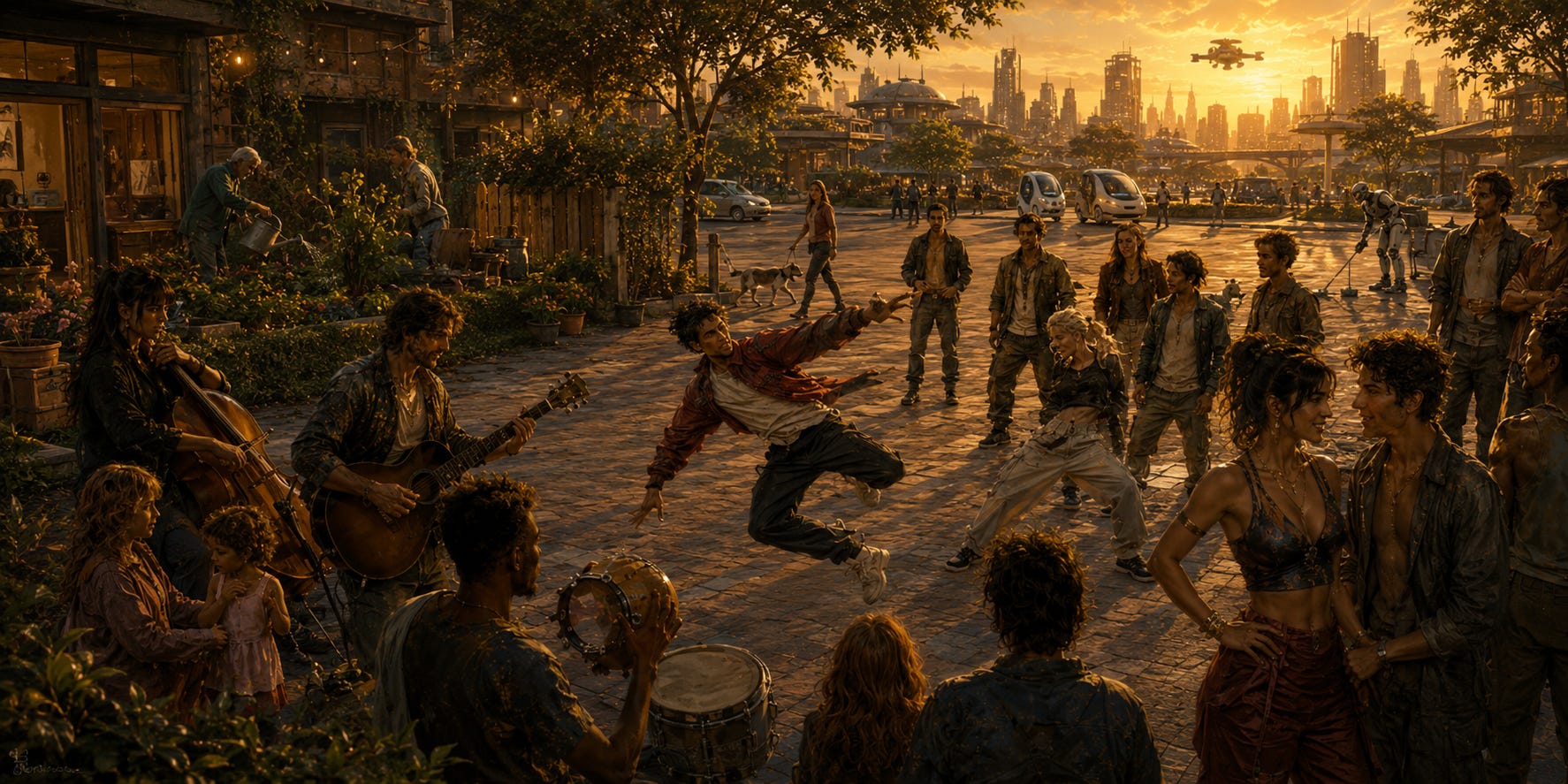
What happens to human life when economic necessity disappears? Much discussion of transformative AI focuses on whether humans will survive, retain control, or receive a fair share of the resulting wealth. Those questions are obviously important. But suppose, for the sake of argument, that the material problem is solved unusually well: AI remains aligned enough to provide abundance, scarcity is managed reasonably, and humans no longer need to work for money. The remaining question is less economic than existential: once people are no longer needed as workers, what will they do with themselves?
I am assuming a scenario where AI can complete any objectively measurable work better than the best human, at negligible cost. I am also assuming that this ASI is benevolent or controlled by benevolent humans, and its approach to benevolence leads to an UBI like material abundance, where the ASI provides whatever scalable products humans desire, and that naturally scarce goods (e.g. land) are distributed in some sort of equitable way. This vision certainly makes me feel uneasy, but seems better than many of the alternatives:
A domineering autocrat controlling AI, who has no need to treat people well because he does not need their labour - i.e. an intelligence curse similar to the resource curse affecting many dysfunctional resource rich countries
Pet, zoo or wildlife reserve like status
Some sort of fate worse than extinction, e.g. analogous to factory farming
For simplicity I am also assuming that all paid work will cease, as opposed to the economy pivoting to jobs where humanness is much of the point of the job, such as hotel door opener or live musician or nanny - this is of course not necessarily the case, but still quite illuminating.
So if all economic value is provided for free by the ASI, what could people do with their energy? Fortunately there are already people today that create little economic value, but are generally considered to have meaningful lives worth living. We can take inspiration from those groups.
Prepubescent children have notable differences to adults in that they have a weaker status drive, and much of what they do is preparation for adulthood. Still, interesting things can be learned from observing young children:
An in-the-present sense of wonder and play. This engagement with life is generally not consciously outcome driven, even though it has outcome-oriented evolutionary origins. Adults can try to cultivate such childlike, outcome-independent joy.
A highly attentive and available adult is much like a benevolent superintelligence from the perspective of a child. Children fortunate to have such adults available still usually choose to engage with other children. Humans similarly may continue to want to connect to other humans even if ASIs are available.
Teenagers usually spend a lot of effort on non-wealth status games: They tend to be highly status driven, because the mating drive is kicking in with force. But wealth-based status games are less suitable for teenagers than for adults (some exceptions like teenage entrepreneurs and flashy trust fund babies notwithstanding), because teenagers have very little money compared to adults, and because whatever money they do have is only loosely linked to their intrinsic capabilities / gene quality. Instead they play status games around
Looks
Athletic prowess
Other skills, such as dancing and singing
Transgressiveness and risk-taking
Style and taste, including creating art (e.g. forming a band)
Social intuition, connectedness and popularity
These status games are often quite local, and I think it will probably continue to be possible to create status games that are resistant to being passed simply by asking a widely available ASI for help.
Bohemians and starving artists, much present in my beloved Berlin, essentially continue to play teenage status games in adulthood:
Avantgarde taste
Transgressiveness through illegal drugs and non-mainstream sexuality
Social proof and intuition demonstrated by getting into selective clubs and house parties
Connection can be deepened and signalled by gifting each other art, without that art having to be better than what is created by professional artists or AIs. I expect such teenage-like, taste- and social proof-based ways of connecting and signalling status to become much more important for adults in a post-ASI world.
Parents put effort into raising their children comparable to full-time jobs. They usually consider this among the most meaningful things they have done in their life. The biological connection between parents and children increases the likelihood that this continues to provide value over children being purely raised by ASIs.
Retirees, having achieved financial freedom, often indulge in hobbies such as gardening, sharing experiences with peers, or embrace giving without expectation of reciprocation in a similar way to parents but more broadly:
Continuing to support their adult children, as well as grandchildren and other relatives
Caring for other elders that are losing independence
Taking opportunities to be kind in day-to-day life
Monks sometimes do enrich themselves, and many work to create external value by teaching others. But especially in the contemplative traditions like Buddhism or yoga, they focus a large share of their efforts on directly pursuing happiness / wellbeing however they understand it, largely independent of external conditions or achievements.
Reflecting on those examples, what might working-age adults end up doing? Much depends on whether there is still a desire for human connection, or whether most people will prefer advanced idealized ASI-created simulacra of human connection. There are already signs of people using digital content to alleviate loneliness. But I expect a full replacement of human connection, if it happens at all, to be significantly further off than humanoid robot laborers. The full range of human connection, including physical presence, contains a huge amount of complexity and subtlety that is barely understood. And of course replacing human connection with machines intuitively feels very icky, even more than replacing all labour.
If there is still a desire for connection with actual humans, I would expect that:
Teenagers and, to a larger degree than now also adults, will continue to find ways to signal status in order to find and keep romantic partners and friends, such as working on their looks, learning difficult skills and developing social proof
Middle aged adults will spend more time on their children, a trend that has already begun , as well as on pets and friendships
Elders will continue to provide care where there is need, and connect where there is an opportunity
The trend of people of all ages increasingly engaging in inner work will continue, both to improve their ability to form fulfilling connections, as well as directly increase their happiness. This can take the form of psychotherapy, whether with humans or AIs, psychedelics, meditation (including increasingly advanced forms , or group experiences.
People of all ages will continue to connect through shared experiences, conversation and art
Interesting thoughts on what this *could* look like. I take a slightly more negative view on things (projecting out already-concerning consumption-oriented screen-time already is and will only get more immersive/attractive to many), so it was nice to read something hopeful, and I appreciated your examples.
The advance of artificial intelligence will reveal that intelligence was never our core characteristic.
There is, of course, no limit to how far machines can go in emulating humans. So whatever essentially human feature you imagine, there will be a point in time when a machine can do it and once they do, they will quickly surpass us. It's not a novel opinion that all this leads to a point where we will just accept machines as members of our society.
In the meantime, any talk about UBI doesn't make any sense to me. Right now, we are just observing new tools, new technology that makes us more productive. The arguments for UBI are as good and as bad as ever.